

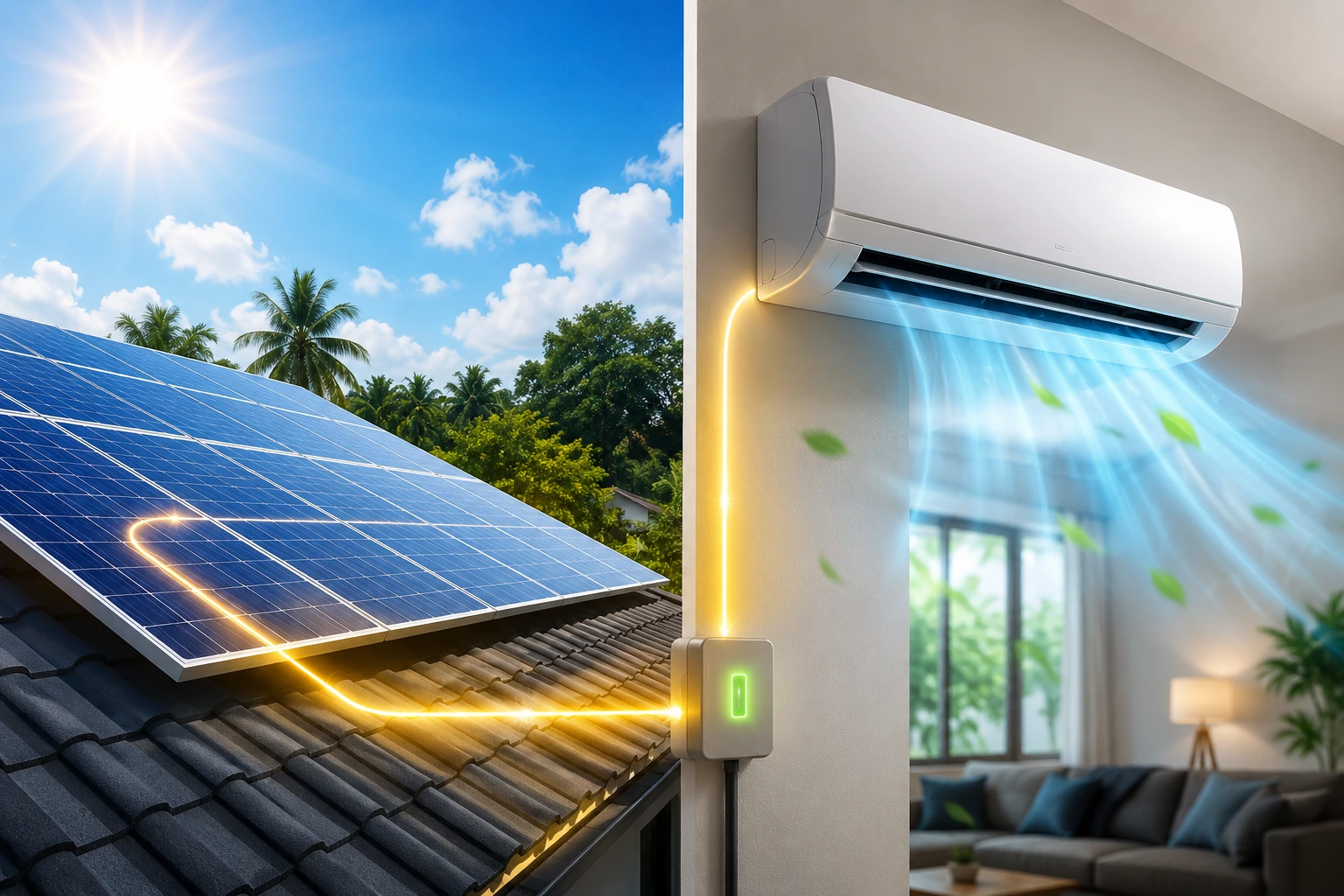
With Kerala's hot and humid weather, air conditioners have become an essential appliance in many homes. However, running an AC for several hours every day can significantly increase your electricity bill.
This leads many homeowners to ask:
Can Solar Panels Run an AC?
The answer is yes. A properly designed solar power system can help offset the electricity used by an air conditioner.
However, the number of solar panels and the solar system size you need will depend on several factors, including the AC capacity, usage hours, electricity consumption and the type of solar system you choose.
In this guide, we explain how solar panels can support AC usage in Kerala and how to estimate the right solar system size for your home.
Can Solar Panels Run an AC?
Yes, solar panels can generate electricity that helps power an air conditioner.
In a typical on-grid solar system, the electricity generated by your solar panels is used to offset your home's electricity consumption while the system is generating power.
A hybrid solar system can combine solar power with the grid and battery storage, depending on the system design.
How Much Electricity Does an AC Use?
The electricity consumption of an AC depends on several factors.
For example, a 1.5-ton inverter AC does not consume the same amount of electricity at all times. Its actual power consumption can change depending on cooling demand and operating conditions.
It is better to check your AC's actual electricity consumption or power rating rather than using a single fixed number for every AC.
How Many Solar Panels Do You Need to Run a 1.5-Ton AC?
There is no single answer because the number of solar panels depends on your AC's electricity consumption and your solar panel wattage.
The final solar system size should be calculated based on the total household electricity consumption, not the AC alone.
A professional assessment can help determine the suitable system capacity based on your electricity consumption, rooftop conditions and expected solar generation.
Example
Imagine that your AC and other household appliances together consume approximately 15 units of electricity per day.
The required solar capacity would then depend on the expected daily solar generation from each installed kW.
How Many Solar Panels Are Required for Different AC Sizes?
The number of panels depends on the total solar system capacity and the wattage of each panel.
For example, if you install 550 W solar panels:
| Solar System Size | Approximate Number of 550 W Panels |
|---|---|
| 1 kW | 2 panels |
| 2 kW | 4 panels |
| 3 kW | 6 panels |
| 4 kW | 8 panels |
| 5 kW | 9–10 panels |
These figures are approximate. The actual system design may vary based on panel wattage and technical requirements.
Is a 3 kW Solar System Enough to Run an AC?
A 3 kW solar system may be suitable for some households with one AC and regular household appliances. However, whether it is enough depends on your actual electricity consumption.
Can Solar Panels Run an AC at Night?
Solar panels do not generate electricity at night because they require sunlight.
However, an AC can still be powered through the grid or through suitable battery storage in a properly designed hybrid system.
☀️ On-Grid Solar
An on-grid solar system can reduce electricity costs by generating solar power during daylight hours.
🔋 Hybrid Solar
A hybrid system can include battery storage for backup power, depending on the system configuration and battery capacity.
Can a 1 kW Solar System Run an AC?
A 1 kW solar system is generally designed for relatively lower electricity consumption.
It may contribute to the electricity used by an AC during strong sunlight hours, but whether it is sufficient depends on the AC's power consumption and the other appliances running in the home.
Can a 2 kW Solar System Run an AC?
A 2 kW system can generate a useful amount of electricity for a small household. However, its suitability depends on the AC capacity, daily usage hours, other household loads, rooftop conditions and expected solar generation.
What Is the Best Solar System for a Home With an AC?
The best solar system depends on your requirements.
☀️ On-Grid Solar
- Your main goal is reducing electricity bills
- You use significant electricity during daytime
- Grid availability is generally reliable
- Battery backup is not your main requirement
🔋 Hybrid Solar
- You need backup power
- Power interruptions are a concern
- You want battery storage
- Selected appliances need backup power
Factors That Affect How Many Solar Panels You Need
Before installing solar panels for a home with an AC, consider these factors.
Your Monthly Electricity Bill
Your electricity bill provides a useful starting point for estimating your solar requirement.
Number of ACs
A home with one occasionally used AC has different requirements from a home with multiple ACs running daily.
AC Usage Hours
Longer AC operation means greater electricity consumption.
AC Efficiency
Energy-efficient inverter ACs may consume less electricity under similar operating conditions.
Other Appliances
Your solar system should be designed around the home's overall electricity consumption.
Rooftop Space
Available shade-free rooftop area affects the maximum solar capacity that can be installed.
How to Calculate the Right Solar System Size for Your Home
A simple approach is to start with your electricity consumption.
Check Your Monthly Electricity Usage
Look at your electricity bills and identify your average monthly consumption.
Calculate Your Daily Average
Monthly consumption ÷ 30 gives an approximate daily electricity consumption.
Consider Your Daytime Electricity Usage
Solar panels generate electricity during daylight hours, so daytime consumption can be important when designing the system.
Assess Your Rooftop
Check the available shade-free area and identify possible shading issues.
Get a Professional Site Assessment
A solar professional can assess your consumption, roof space, system design and local conditions.
Do Solar Panels Work During Kerala's Monsoon?
Yes — but generation can be lower
Solar panels can still generate electricity on cloudy and rainy days, although generation is generally lower when sunlight levels are reduced.
Rain itself does not stop a properly installed solar panel system from functioning. However, extended periods of cloud cover and reduced sunlight can affect overall generation.
For Kerala homeowners, it is important to consider annual generation rather than judging a solar system only by its output during the monsoon season.
Tips to Get Better Solar Performance in a Home With AC
Planning to Install Solar Panels for Your Home in Kerala?
If you are wondering how many solar panels you need to run your AC and other household appliances, the first step is to understand your electricity consumption and available rooftop space.
At Allsun Nature, we help homeowners explore suitable solar solutions based on their energy requirements, rooftop conditions and installation needs.
Get Expert Solar Guidance →Frequently Asked Questions
Recent Blogs

Best Solar System for a 2BHK, 3BHK or 4BHK Home in Calicut
Sep 17, 2026
Why Is My Solar Panel Generating Less Power in Kerala?
Sep 16, 2026
Not All Solar Systems Are the Same: Find the Right One for Your Calicut Property
Sep 15, 2026
Kerala’s Power Crisis: Can Solar Help Homes Cope With Rising Power Cuts?
Sep 14, 2026
3kW vs 5kW Solar System for Kerala Homes: Cost, Power Generation & AC Usage
Sep 14, 2026
Solar Panel Installation in Kerala: Cost, Process, Subsidy & How to Choose the Right Company
Sep 11, 2026
How to Choose the Right Solar System Size for Your Home in Calicut
Sep 10, 2026
Solar Panel Maintenance in Kerala: A Homeowner's Guide for Coastal Cities
Sep 09, 2026
On-Grid Solar System in Kerala: How It Works, Cost, Benefits & KSEB Connection
Sep 08, 2026
Solar Installation in Calicut: From Panel Selection to KSEB Connection
Sep 08, 2026Switch to Solar Today!
Save up to 90% on electricity bills with Allsun Nature's customized rooftop solar solutions.
Get Free Quote