

Choosing the right solar panel is one of the most important decisions when planning a rooftop solar system. Homeowners in Kerala often come across two commonly discussed technologies: monocrystalline and polycrystalline solar panels.
Both technologies can generate electricity from sunlight, but they differ in their manufacturing process, appearance, efficiency, space requirements and typical applications.
If you are planning solar panel installation in Kerala , understanding these differences can help you have a more informed discussion with your solar installer instead of choosing a panel based only on price.
What Are Monocrystalline Solar Panels?
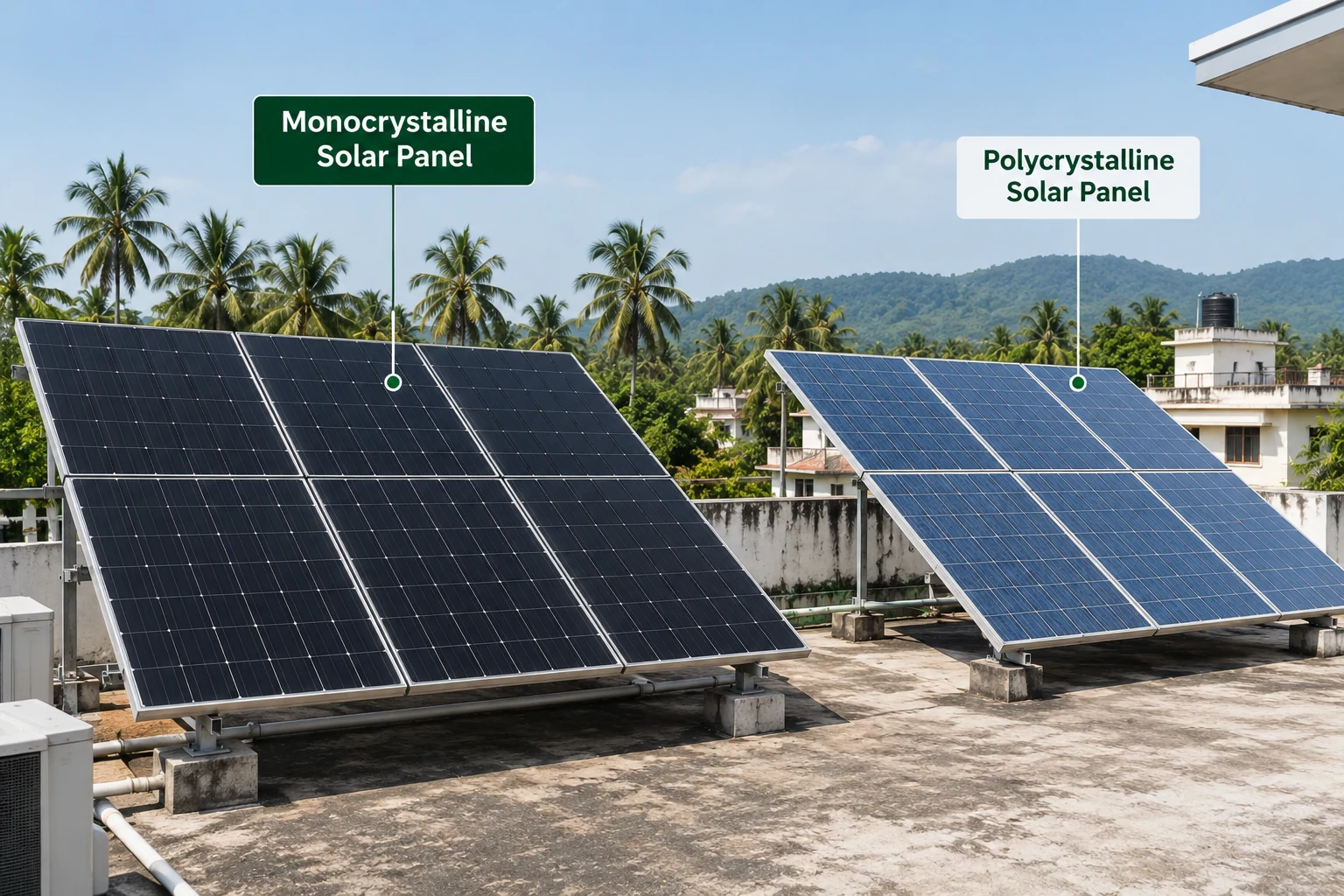
Monocrystalline solar panels are manufactured using solar cells made from a single-crystal silicon structure.
They are commonly recognized by their dark or black appearance and are widely used in residential rooftop installations.
One of their important characteristics is their relatively high power output per unit of panel area. This can be particularly useful when rooftop space is limited.
For homeowners considering solar panels for homes , available roof area is an important factor when comparing different panel technologies.
Common Characteristics of Monocrystalline Panels
- Higher efficiency options are widely available
- Darker appearance
- Good power output from a given panel area
- Suitable for residential rooftops
- Useful where available roof space is limited
- Available in modern technologies such as TOPCon and other advanced cell designs
What Are Polycrystalline Solar Panels?
Polycrystalline solar panels are also based on silicon cells, but the manufacturing process differs from monocrystalline technology.
They traditionally have a blue-toned appearance and were widely used in residential and commercial solar installations.
Compared with many modern monocrystalline products, conventional polycrystalline panels generally have lower efficiency, meaning more panel area may be required to achieve the same total system capacity.
Important: Panel technology continues to evolve, so homeowners should compare the actual specifications of the modules being quoted, rather than relying only on whether a panel is labelled mono or poly.
Monocrystalline vs Polycrystalline: Key Differences
| Feature | Monocrystalline | Polycrystalline |
|---|---|---|
| Silicon structure | Single-crystal | Multiple silicon crystal structures |
| Typical appearance | Dark / Black | Blue |
| Efficiency | Generally higher in comparable product ranges | Generally lower in comparable traditional products |
| Space requirement | Less area for the same output, depending on module | May require more area for equivalent output |
| Residential use | Common | Historically common |
| Roof-space advantage | Strong | May require more space |
| Technology options | Widely available in newer high-efficiency formats | More traditional technology |
| Price | Can vary by technology and brand | Historically positioned as a lower-cost option |
These are general technology-level differences. The specifications of individual solar modules can vary significantly between manufacturers and product generations.
Which Solar Panel Is More Efficient?
Efficiency describes how effectively a solar panel converts available sunlight into electrical energy.
For example, if two panels have the same physical dimensions but one has a higher efficiency rating, the higher-efficiency panel can generally produce more rated power from a similar amount of roof space.
This is one reason modern high-efficiency technologies are increasingly considered for residential rooftops.
However, panel efficiency should not be the only factor.
- Rated power
- Module efficiency
- Temperature coefficient
- Product warranty
- Performance warranty
- Degradation specifications
- Panel dimensions
- Inverter compatibility
- Manufacturer
- Installation conditions
Which Is Better for Kerala Homes?
There isn't one panel type that is automatically suitable for every home in Kerala.
The right choice depends on your:
Does Kerala's Climate Affect Solar Panel Selection?
Kerala receives strong sunlight during many periods of the year, but the state also experiences monsoon conditions, humidity, cloudy weather and rainfall.
Therefore, homeowners should consider more than the headline efficiency number.
When Comparing Solar Modules, Ask About
- Temperature coefficient
- Product durability
- Warranty
- Performance warranty
- Resistance to environmental conditions
- Manufacturer specifications
- Installation quality
The overall solar system design also has a major impact on actual generation.
Monocrystalline Panels for Limited Roof Space
One of the major reasons homeowners consider monocrystalline panels is space efficiency.
Suppose two solar systems need to provide a similar total capacity. If one type of panel provides more power from each square metre, it may require less rooftop area.
Is Polycrystalline Still Relevant?
Polycrystalline technology has historically been widely used in solar installations, but the solar module market has changed considerably.
Modern homeowners may encounter newer technologies and product designs when comparing quotations.
Therefore, rather than automatically rejecting a panel because it is polycrystalline—or choosing a panel simply because it is monocrystalline—compare the actual module specifications and complete system proposal.
Does the proposed panel provide the required performance for your roof, electricity consumption and budget?
What About TOPCon Solar Panels?
When researching the best solar panels, homeowners will also encounter technologies such as TOPCon.
TOPCon is a newer cell technology that can provide high efficiency and is increasingly available in residential solar modules.
Allsun Nature's existing guide discusses newer high-efficiency panel technologies and explains that panel selection should consider electricity usage, roof space, budget and the type of solar system required.
So, when comparing a quotation, don't stop at the words “mono” or “poly.”
Check the actual panel model and specification sheet.
What Should You Check Before Buying Solar Panels?
Before finalizing your solar system, ask the installer for the following information.
Don't Choose a Solar Panel Based Only on Price
A cheaper panel quotation doesn't necessarily mean a lower overall project cost.
For example, two quotations may both offer a 5kW system but use different:
- Panel technologies
- Panel brands
- Inverters
- Mounting structures
- Protection equipment
- Warranty terms
- Installation standards
Compare the complete system, not simply the price per panel or price per kW.
How Does Panel Selection Connect With Your Solar System?
Selecting the panel is only one part of planning a solar installation. Your final system should also consider whether you need:
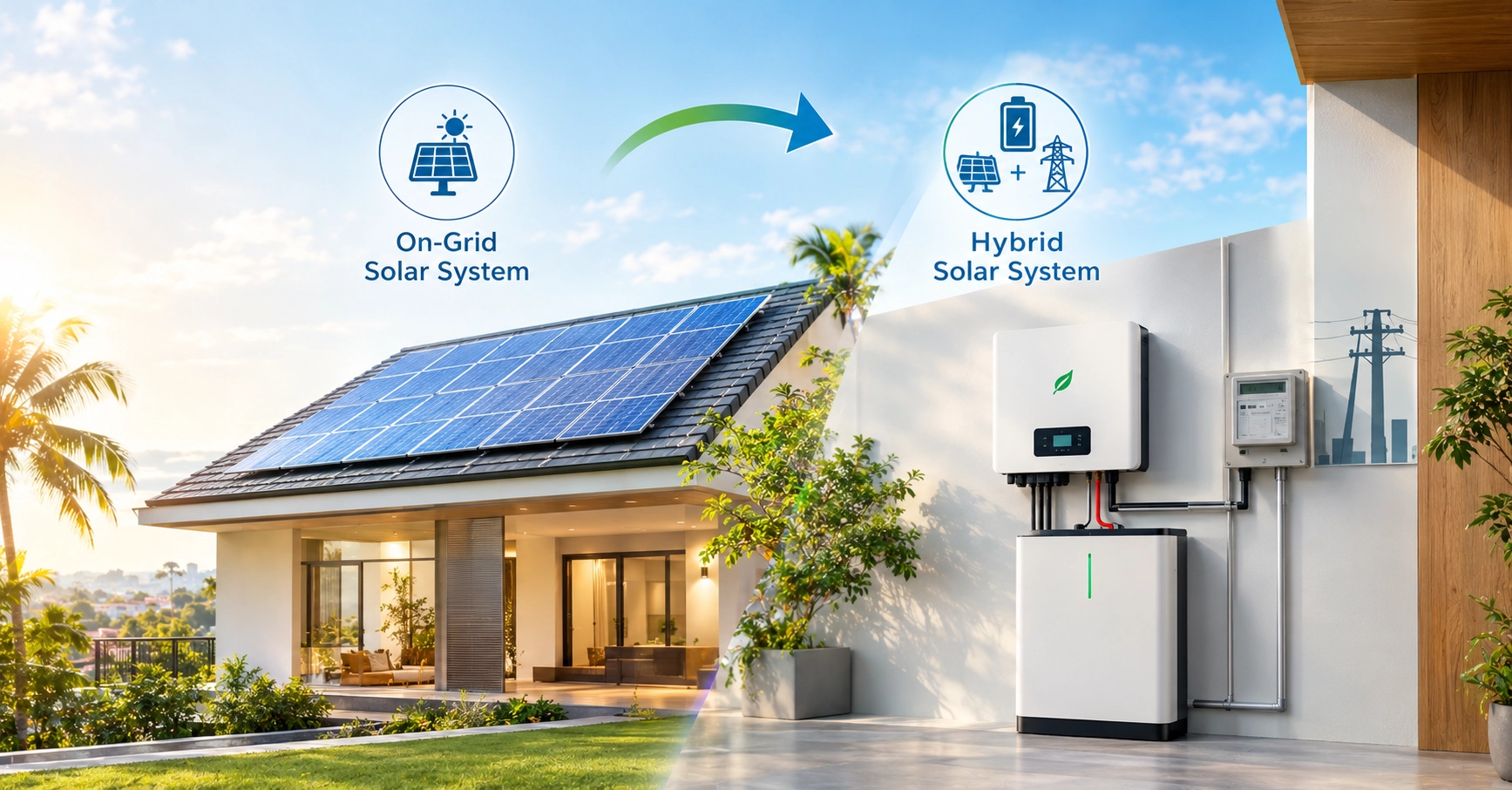
On-Grid Solar
An on-grid system remains connected to the electricity grid and is commonly considered by homeowners who want to generate solar electricity while retaining their grid connection.
Explore On-Grid Solar →Hybrid Solar
A hybrid system can combine solar generation with battery storage when backup power is part of the requirement.
Off-Grid Solar
An off-grid system is designed to operate independently of the electricity grid and normally includes battery storage.
Explore Off-Grid Solar →The appropriate configuration depends on the property's electricity consumption, backup requirements, roof conditions and budget.
Monocrystalline vs Polycrystalline: Which Should You Choose?
Instead of asking only “Which panel is better?”, ask:
- How much electricity does my home consume?
- How much usable roof space do I have?
- Is shading an issue?
- What system capacity do I need?
- What panel efficiency is being offered?
- What are the warranty terms?
- Which inverter is included?
- What installation components are included?
- What after-sales support is provided?
For many homeowners with limited rooftop space, higher-efficiency monocrystalline options can be attractive because they can provide more power from a given area. But the final decision should be based on the specific panel model and complete solar system design, not the technology name alone.
Final Thoughts
Choosing between monocrystalline and polycrystalline solar panels is an important step when planning a solar system for your home in Kerala.
Monocrystalline panels are widely available in higher-efficiency formats and can be particularly useful when rooftop space is limited. Polycrystalline panels have also played an important role in the solar industry, although homeowners today may encounter a wider range of newer module technologies.
The best approach is to compare the actual specifications, efficiency, warranty, dimensions, inverter, installation quality and overall quotation before making a decision.
If you're planning solar panel installation in Kerala , a proper site assessment can help determine which panel technology and system configuration fit your property.
Planning Solar Installation in Kerala?
Get a solar system designed around your electricity consumption, available roof space and property requirements.
Get a Free Solar Consultation